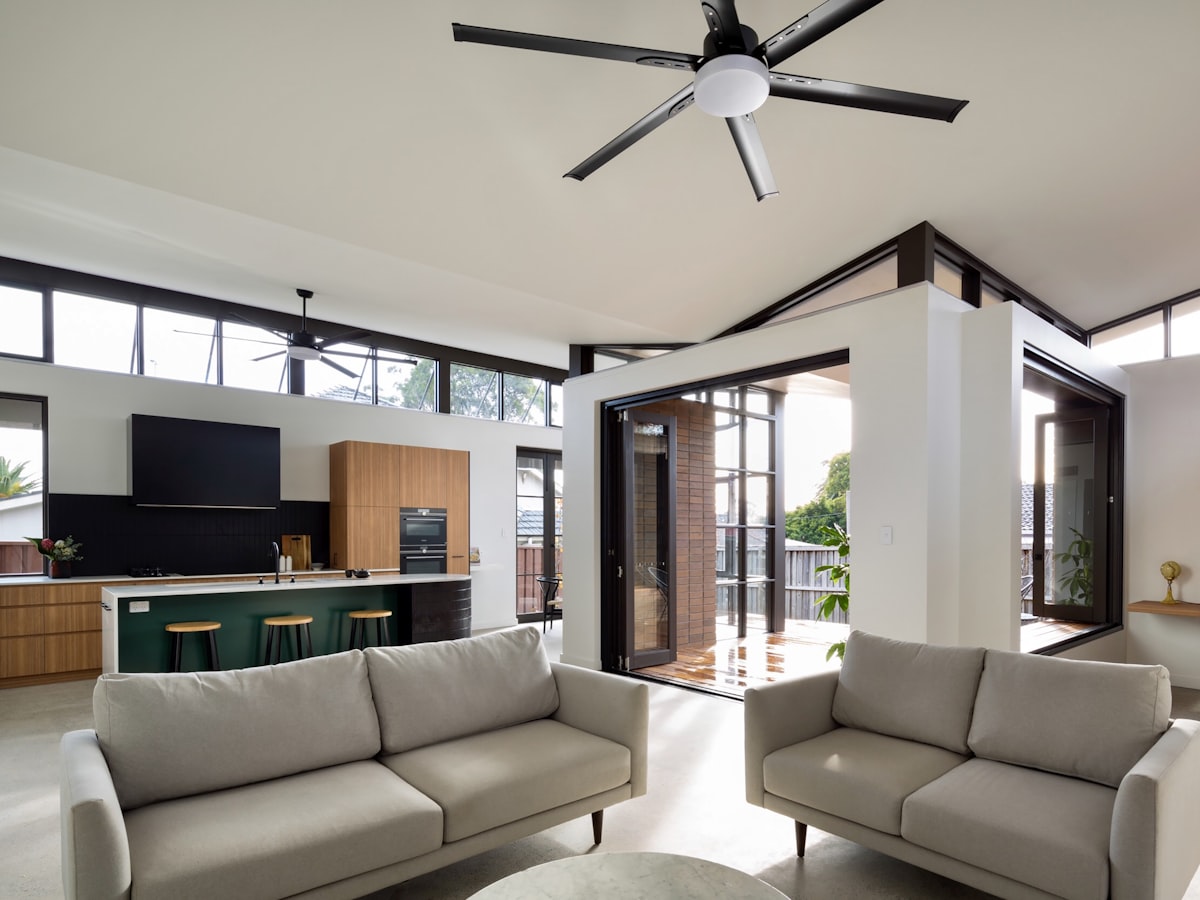
A ceiling fan is one of the few home upgrades that pays you back every single month, but only if you buy the right one. Get the size wrong and a beautiful fan will barely stir the air in a big living room, or churn like a helicopter over a small bedroom. Size is the spec that makes or breaks the whole purchase, and it's the one most people guess at.
The good news: matching a fan to a room isn't a design mystery, it's basic arithmetic. Measure your room, translate square footage into a blade span, and check a couple of clearances. Do that first, and everything else — the motor, the light, the finish — becomes a much easier decision. Here's exactly how to get it right.
How to size a ceiling fan to your room
The core spec on any ceiling fan is its blade span — the diameter of the circle the blades sweep, measured tip to tip in inches. Bigger rooms move more air, so they need a bigger span. Here's the rule we use, matched by blade span to room area: rooms up to about 75 sq ft want a 29–36" fan; roughly 75–175 sq ft calls for 42–48"; 175–300 sq ft wants 52–56"; and anything larger should step up to 60"+ or use two fans.
To use it, just multiply your room's length by its width. Say you have a 12 ft by 14 ft bedroom: 12 × 14 = 168 sq ft. That lands in the 75–175 sq ft band, so you want a 42–48" fan — a 48" is a safe, breezy pick for that size. A snug 8 × 9 ft office (72 sq ft) drops into the smallest band and only needs a 29–36" fan; put a big 52" there and it'll feel overpowering and pushy. A 20 × 18 ft great room (360 sq ft) blows past the top band, so reach for a 60"+ fan or hang two properly spaced fans instead of one straining unit.
When you land right on a boundary, size up rather than down — a slightly larger fan run on a low speed is quieter and comfier than a small one maxed out. And measure the actual open floor area, not the footprint including a walk-in closet or an alcove the air won't reach.
The specs that matter beyond size
Once the span is right, airflow is what you're really buying. It's rated in CFM (cubic feet per minute) and it's the honest measure of how much air a fan actually moves. Two 52" fans can perform very differently, so compare CFM directly — a higher number at a lower wattage means a fan that's both breezier and cheaper to run.
The motor is the next thing to weigh. DC motors cost a bit more up front but use noticeably less energy, run quieter, tend to offer more speeds, and usually come with a remote. AC motors are the traditional, more affordable option and are perfectly fine — just expect a little more hum and a bit higher energy use. Blade pitch (the angle of the blades, ideally around 12–15 degrees) also matters: too flat and the fan looks busy without moving much air.
Don't overlook the boring stuff that you'll live with daily. Check the mounting type and whether it fits your ceiling height, confirm there's a light kit if you need one (and whether the bulbs are replaceable), and look for a quiet motor rating. A fan you can hear over the TV gets switched off, and a fan that's off is saving you nothing.
Choosing between the main types
Start with your ceiling height, because it dictates the mount. Standard flush or downrod mounts assume roughly 8–9 ft ceilings. For low ceilings under 8 ft, a hugger (flush-mount) fan keeps blades safely overhead. For high or vaulted ceilings, you'll want a longer downrod to drop the fan into the 8–9 ft sweet spot where you actually feel it — a fan stranded 12 ft up looks nice and does very little.
Next, match the fan to the room's environment. Indoor fans are for dry, conditioned rooms only. For a covered porch or a steamy bathroom, buy one rated damp; for anything exposed to rain or splashing, buy one rated wet. Using an indoor fan outdoors is a genuine safety and longevity problem, not a shortcut.
After that it's mostly features and looks. Decide whether you want DC efficiency and a remote versus a simpler AC pull-chain, whether you need integrated light, and whether smart controls (app or voice) are worth it to you. These are preferences — none of them fix a fan that's the wrong size or the wrong mount for your ceiling.
Placement, setup, and running it efficiently
Hang height is where a lot of good fans get wasted. Aim to put the blades 8–9 ft off the floor — that's the height where the breeze reaches you without the fan feeling like it's in your hair. Keep the blade tips at least 18" from the nearest wall or sloped ceiling, and ideally center the fan over the space people actually sit, not the geometric center of an oddly shaped room.
Use the seasonal direction switch, because it's free comfort. In summer, blades should spin counterclockwise (looking up) to push a cooling breeze straight down. In winter, flip them to clockwise on low to pull cool air up and gently push warm air back down along the walls, which lets you dial the thermostat back a touch.
Finally, remember that fans cool people, not rooms — they work by moving air over your skin, not by lowering the temperature. So turn the fan off when you leave, and don't expect it to cool an empty room. Paired with your AC or heat, a correctly sized fan running on a modest speed lets you nudge the thermostat and feel the same, which is where the real savings come from.
Common mistakes to avoid
- ✕Buying by looks and guessing the size — measure the room first, then pick the span.
- ✕Sizing down at a boundary; a bigger fan on low beats a small one on high.
- ✕Hanging it too high on a vaulted ceiling, so you never feel the breeze.
- ✕Putting an indoor fan on a porch or in a bathroom instead of a damp- or wet-rated one.
Get your exact number
Skip the guesswork — the ceiling fan calculator sizes yours in about ten seconds.
Frequently asked questions
What size ceiling fan do I need for a 12x12 room?
A 12 by 12 ft room is 144 sq ft, which falls in the 75–175 sq ft band, so a 42–48" fan is the right call. A 44" or 48" span will move plenty of air without dominating the space. When you're between sizes, go with the larger one and run it on a lower speed.
Is it better to get a bigger or smaller ceiling fan?
When you're on the fence between two sizes, size up. A larger fan run at a low or medium speed moves the same air more quietly and comfortably than a small fan straining at top speed. Just don't oversize dramatically — a huge fan crammed into a tiny room feels pushy and looks off.
How high should a ceiling fan hang?
Aim to have the blades 8–9 ft above the floor, which is the height where you actually feel the breeze. On low ceilings under 8 ft, use a flush-mount hugger fan for safe clearance. On tall or vaulted ceilings, add a longer downrod to bring the fan down into that 8–9 ft range.
How far should a ceiling fan be from the wall?
Keep the blade tips at least 18" from the nearest wall, and the same from any sloped ceiling. Closer than that and airflow gets choked and the fan can feel cramped. Center it over the area where people sit or sleep rather than the exact middle of an irregular room.
Do ceiling fans actually save on energy bills?
Yes, but indirectly — a fan cools people, not the room, by moving air over your skin. That lets you raise the thermostat a few degrees in summer and feel just as comfortable, which is where the savings come from. Because a fan does nothing for an empty room, turn it off when you leave.
Our top ceiling fans
GearSizer may earn a commission on purchases made through links on this page. Learn more.