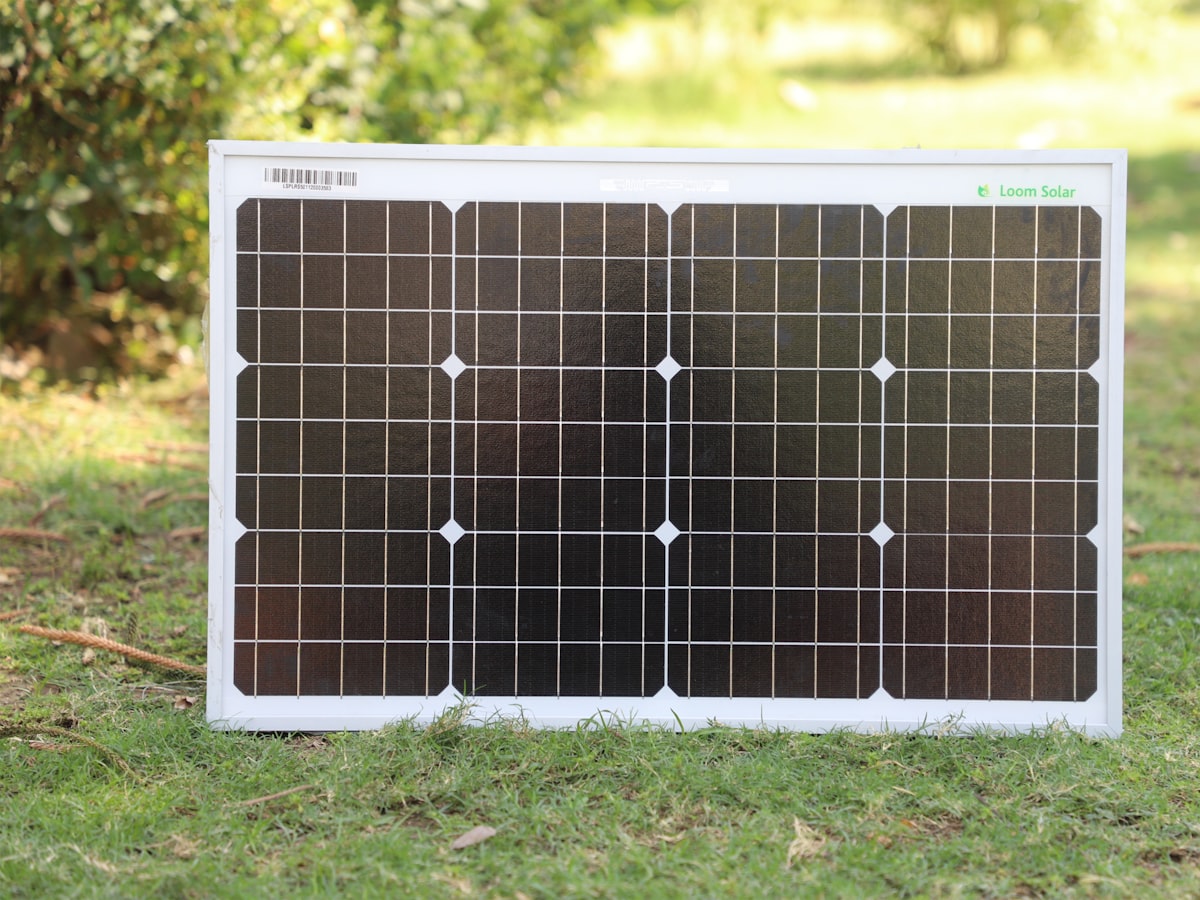
A solar panel only earns its keep if it can actually refill whatever you're draining. Buy too small and you'll watch your power station's battery percentage crawl backward on a cloudy afternoon; buy too big and you've overpaid for wattage your input port can't even accept. The good news is that the right size isn't a guessing game — it comes down to a little arithmetic you can do on the back of a receipt.
This guide walks you through the one formula that matters, the specs to check beyond the headline wattage, and how to pick between the panel types on the shelf. The core spec to anchor on is solar watts — but as you'll see, watts alone won't save you if the voltage doesn't match your gear.
How to size your solar panel (the only formula you need)
Start with what you actually consume, not what the panel promises. Add up the daily watt-hours (Wh) of everything you want to recharge or run in a day — your phone, a fan, a fridge, some lights. Then use this rule: divide your daily watt-hours by your local peak sun hours, and add about 30% for real-world losses. That gives you the panel wattage to shop for.
Here's the worked example. Say you use 600 Wh a day and you live somewhere that gets about 4 peak sun hours (a reasonable average across much of the U.S.). That's 600 ÷ 4 = 150 W of theoretical panel. But panels almost never hit their rated number in the field — heat, dust, imperfect angles, cable losses, and hazy skies all skim off the top. Add ~30% and you land around 195 W, so you'd buy a ~200 W panel. Round up, not down.
Two things quietly move this math. First, peak sun hours are regional: the desert Southwest can see 5.5–6.5, while the Pacific Northwest may only give you 3.5–4 in good months and far less in winter. Fewer sun hours means you need more watts to move the same energy. Second, that 30% cushion is a minimum for clear days — if you need reliable recharging in shoulder seasons or partial shade, sizing up to 1.5x or even 2x your calculated wattage is money well spent.
The specs that matter beyond wattage
Wattage tells you the ceiling; voltage tells you whether you'll ever reach it. Every power station has an MPPT charge controller with an input voltage window — say 12–30 V, or 11–60 V, or up to 150 V on larger units. Your panel's operating voltage (Vmp) has to sit above the station's minimum or the controller can't even lock on, and you'll stare at a frustrating 0 W of input while the panel sits there producing power into the void. Match the panel's voltage to your station's input range before you fall in love with a wattage number.
There's a ceiling to respect too. A panel's open-circuit voltage (Voc) climbs in the cold — 10–20% higher below freezing — so a panel that reads fine on a summer spec sheet can overshoot your station's max input on a frigid morning and trigger a shutdown or, worse, damage. Leave headroom, and check that the connector matches (many stations use XT60, MC4, or a barrel plug, and adapters are common but not universal).
After voltage, look at cell type and honesty. Monocrystalline cells are the standard for good reason — better efficiency per square inch than older polycrystalline. And treat a panel's rated watts as a best-case lab number (STC); a reputable brand's real-world output runs meaningfully lower, which is exactly why the sizing rule builds in that 30% loss factor.
Rigid, portable folding, or flexible: how to choose
There are really three camps, and the right one depends on how you'll live with it. Rigid glass panels are the workhorses — highest efficiency, longest lifespan, lowest cost per watt — but they're heavy, bulky, and want a permanent-ish home like an RV roof or a fixed ground spot. If the panel stays put, buy rigid and don't overthink it.
Portable folding panels (the briefcase-style suitcases with a built-in kickstand) are the sweet spot for most power-station owners. They fold down to carry, prop up at an angle in seconds, and usually ship with the right cable for popular stations. You pay a bit more per watt and sacrifice a little durability versus glass, but for camping, tailgating, and emergency backup, the convenience is worth it.
Flexible panels are the specialists. They're thin, light, and curve to fit a van roof or boat deck, but they run hotter, tend to be less efficient, and generally don't last as long — the flex that makes them useful is also what stresses the cells. Buy flexible only when a curved or weight-critical surface leaves you no choice; otherwise a folding panel serves you better.
Placement and setup: squeezing out the watts you paid for
The best panel aimed badly loses to a mediocre panel aimed well. The single biggest lever is angle: tilt the panel so it faces the sun as directly as possible, roughly perpendicular to the incoming rays. A flat-on-the-ground panel can give up a large chunk of its output compared with the same panel propped and angled toward the sun — which is why those folding kickstands matter more than people think.
Shade is the silent killer. Because cells are wired in series, a single shadow — a branch, a tent pole, even the panel's own cable draped across it — can knock down the whole panel's output, not just the shaded slice. Keep the face totally clear, and plan to reposition a couple of times a day as the sun moves rather than setting it once and walking away.
A few smaller habits add up: keep the panel cool and ventilated (heat quietly cuts efficiency, so don't let it bake flat against a hot surface), wipe off dust and pollen, and use the shortest, thickest cable that reaches to minimize voltage drop. And be realistic about weather — your clear-day sizing math assumes clear days, so keep the power station topped up before a stretch of clouds rather than counting on the panel to dig you out of a low battery.
Common mistakes to avoid
- ✕Buying by wattage alone and ignoring the voltage match — a mismatched panel can read 0 W into your station.
- ✕Sizing for a perfect sunny day, then getting stranded the first time clouds or short winter sun hours show up.
- ✕Trusting the sticker watts as real output instead of building in the ~30% real-world loss cushion.
- ✕Laying the panel flat on the ground and letting a cable, pole, or branch cast shade across the cells.
Get your exact number
Skip the guesswork — the solar panel calculator sizes yours in about ten seconds.
Frequently asked questions
How many solar panels do I need for my power station?
Usually one panel of the right wattage, not several small ones. Divide your daily watt-hours by your local peak sun hours and add about 30% for losses to get the target wattage — for example, 600 Wh ÷ 4 sun hours ≈ 150 W, so a ~200 W panel. If you need faster or more reliable charging, size up rather than adding mismatched panels.
Will any solar panel work with any power station?
No — the panel's voltage has to fall inside your station's MPPT input window, and the connector has to match (or adapt). If the panel's operating voltage is below the station's minimum, you'll get little or no charging even in full sun. Always check the input voltage range and port on your station before buying a panel.
How many watts of solar do I actually need?
Take your daily energy use in watt-hours, divide by your area's peak sun hours, and add roughly 30% for real-world losses. That number is your minimum panel wattage. If you charge in cloudy climates or winter, sizing to 1.5x–2x that figure gives you a comfortable margin.
Why is my solar panel charging so slowly?
The most common culprits are angle, shade, and heat. A flat or poorly aimed panel, a shadow across even one corner, or a panel baking against a hot surface can all cut output sharply. Tilt it toward the sun, keep the whole face clear and ventilated, and clean off any dust.
Are portable folding solar panels worth it over rigid ones?
For most power-station owners, yes. Folding panels cost a bit more per watt and are slightly less durable than rigid glass, but they're far easier to carry, set up, and aim — and they usually come with the right cable. Choose rigid only if the panel will live in one fixed spot like an RV roof.
Our top solar panels
GearSizer may earn a commission on purchases made through links on this page. Learn more.